On‑grid, hybrid or off‑grid solar: which should you choose? 2026
For most Thai homes in 2026 an on‑grid system pays best: a 5 kW system costs about 160,600 THB and qualifies for both the tax deduction and the government grant [1][2][3]. A hybrid system with a 7 kWh battery costs 296,800 THB and suits homes that want backup power in an outage [4]. An off‑grid system is for places with no utility supply, such as orchards or farms far from the power lines.
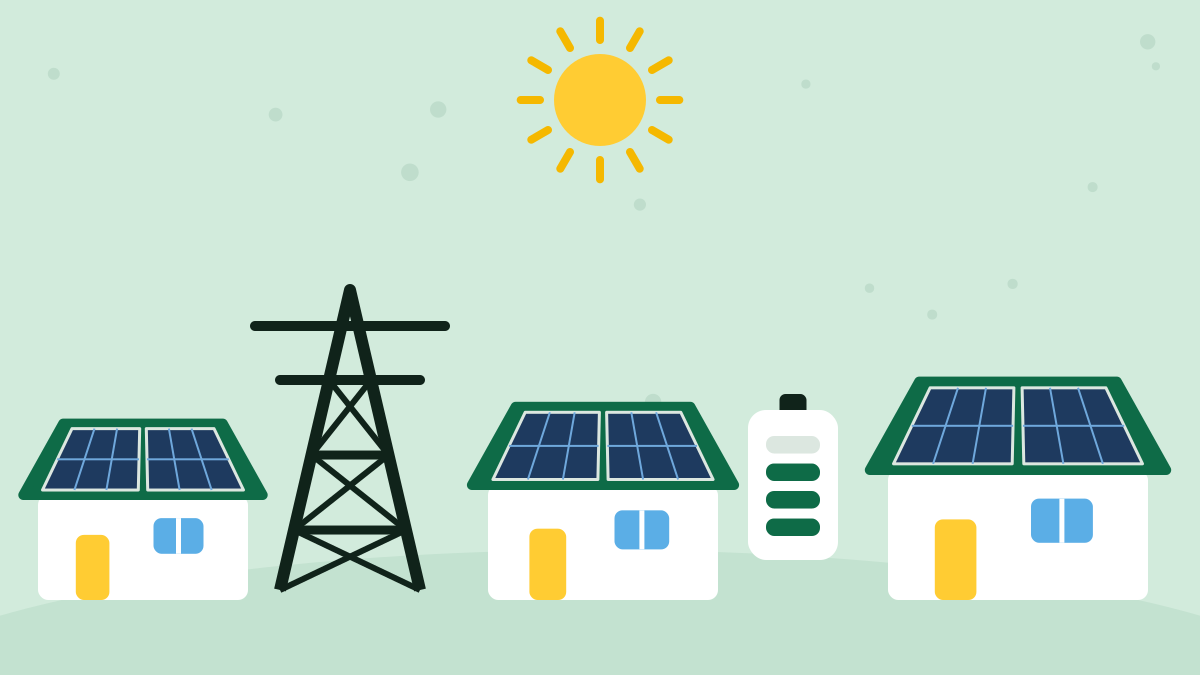
Key facts
- An on‑grid system is connected to the utility, uses solar power first and draws from the grid for the rest, and shuts down in an outage.
- A hybrid system is connected to the grid and a battery, and can power backup circuits in an outage if backup is wired in.
- An off‑grid system is not connected to the utility and needs enough battery for the night and cloudy days.
- The 200,000 THB tax deduction applies only to on‑grid systems connected to MEA or PEA (the Metropolitan and Provincial Electricity Authorities, กฟน. and กฟภ., Thailand's two state power distributors) [3].
- Any system wired into a home supplied by the utility must apply for grid connection, even if it uses all its own power [5].
- Surplus sells for 2.20 THB per kWh, up to 5 kW per meter, for connected systems only [6].
kWp is the peak capacity of the solar panels; kW is the size of the inverter or the system.
The three systems compared
| Feature | On‑grid | Hybrid | Off‑grid |
|---|---|---|---|
| Connected to the utility | Yes | Yes | No |
| Battery | No | Yes, or added later | Required |
| Power during an outage | No | Yes, if backup circuits are wired | Yes |
| Can sell power back | Yes, 2.20 THB per kWh [6] | Yes | No |
| 200,000 THB tax deduction | Yes [3] | Yes if grid-connected, according to published reports | No |
| Example 5 kW price (THB) | 160,600 [1] | 296,800 with 7 kWh battery [4] | Depends on battery size |
| Utility approval | Required [5] | Required [5] | Not required if not wired into a utility-supplied home |
Prices as of 13 November 2026 from Synnex packages at JIB with Huawei equipment. The Kuan Hiw Saeng reference prices for September 2026 are 95,000 to 180,000 THB for a 5 kW on‑grid system and 180,000 to 200,000 THB for a 5 kW hybrid with a 5 kWh battery [7].
Which system should you choose?
| If your home | Suitable system | Why |
|---|---|---|
| Uses a lot of power in the daytime, such as home working or daytime air conditioning | On‑grid | Each self-used kWh saves about 4.84 THB and payback is fastest [2] |
| Has frequent power cuts or equipment that must stay on | Hybrid | The battery powers essential circuits in an outage |
| Plans to add a battery within one to three years | On‑grid with a hybrid inverter | A battery can be added later without replacing the inverter |
| Is far from the power lines, such as an orchard, farm or cabin | Off‑grid | Extending the utility supply may cost more than an off‑grid system |
| Uses power mostly at night and rarely loses power | A small on‑grid system, or none yet | A battery takes longer to pay back than its warranty; see are batteries worth it? |
Why does on‑grid solar stop in a power cut?
An on‑grid inverter must stop supplying power when the utility supply fails, so that power does not flow back into lines that crews are repairing. This is called anti-islanding protection and is a condition for inverters on the utility's list [5]. So even on a sunny day, a home with an on‑grid system has no power during an outage. A hybrid system solves this by disconnecting the home from the grid and powering backup circuits from the battery and panels.
What to know before you choose
- A system whose inverters total more than 5 kW needs an export limiting device [5].
- A hybrid inverter must be on the utility's list, just like an on‑grid inverter; see which solar inverter?
- Backup supplies only the circuits wired to it; ask the installer which circuits get power.
- An off‑grid system in a home that also has a utility meter must be truly separated from that supply; if in doubt, ask an electrical engineer.
Read next: Is solar worth it?, Solar with battery prices, Permits step by step, installer rankings and how we score.
Frequently asked questions
What is the difference between on‑grid, hybrid and off‑grid?
On‑grid is connected to the utility with no battery, hybrid is connected and has a battery, and off‑grid is not connected and relies entirely on its battery. On‑grid is cheapest and pays back fastest, hybrid gives backup in an outage, and off‑grid suits places with no power lines.
Does an on‑grid system work in a power cut?
No. An on‑grid inverter must stop when the utility supply fails, to protect crews repairing the lines, even if the sun is shining. For power during an outage you need a hybrid system with a battery and backup circuits wired in.
How much more does hybrid cost than on‑grid?
In Synnex's packages at JIB, a 5 kW on‑grid system costs 160,600 THB and a hybrid with a 7 kWh battery 296,800 THB, a difference of 136,200 THB. The Kuan Hiw Saeng reference price for a 5 kW hybrid with a 5 kWh battery is 180,000 to 200,000 THB. The difference depends mainly on battery size.
Does off‑grid solar need utility approval?
No grid-connection application is needed if the system is never wired into a home supplied by the utility. If it shares circuits with a utility meter, it must apply for connection to MEA or PEA and use a listed inverter, whether or not it uses all its own power.
Does a hybrid system qualify for the tax deduction?
The solar tax deduction covers on‑grid systems of up to 10 kWp connected to the utility. Published reports say a battery can be included when it is part of a connected system, within the 200,000 THB overall cap. Ask the seller to invoice the whole system together, and check with the Revenue Department if unsure.
Can I start on‑grid and switch to hybrid later?
Yes, but if your inverter is on‑grid only you must replace it or add an AC-coupled battery, which costs more. Homes expecting a battery within one to three years therefore usually choose a hybrid inverter from the start, even before buying the battery.
Sources
- JIB: Synnex Solar Roof Huawei Core 5 kW 1-phase, installed, 160,600 THB. https://www.jib.co.th/web/product/readProduct/86301 Read 13 November 2026.
- Government Public Relations Department: the new tariff structure from September 2026. https://www.prd.go.th/th/content/category/detail/id/33/iid/536793 Published 30 August 2026, read 13 November 2026.
- Daily News: conditions for the solar tax deduction, on‑grid systems connected to MEA or PEA. https://www.dailynews.co.th/news/5811191/ Read 17 November 2026.
- JIB: Synnex Solar Roof Huawei Save 5 kW 1-phase with 7 kWh battery, installed, 296,800 THB. https://www.jib.co.th/web/product/readProduct/86308 Read 13 November 2026.
- Thansettakij: selling power to the utility in 2026, equipment and document requirements. https://www.thansettakij.com/general-news/663189 Read 13 November 2026.
- Government Public Relations Department: National Energy Policy Council meeting 3/2026, 2.20 THB per kWh for 20 years. https://www.prd.go.th/th/content/category/detail/id/39/iid/542862 Published 18 September 2026, read 16 November 2026.
- Post Today: Kuan Hiw Saeng reference prices for September 2026. https://www.posttoday.com/smart-city/751215 Published 30 October 2026, read 17 November 2026.